Platform Architecture & Trust Model
Engineered for physical reality
Math before AI
We built an engine of deterministic code that checks and normalizes the raw facts read from an electronic component PDF, then turns them into CAD files. AI only reads the PDF and feeds that engine; the code checks what the model read, and uncertain results are flagged for engineer review.
The Physical Reality of Hardware
Software can crash and restart. Hardware burns.
In software, a model hallucination can end as an exception in the console. In hardware, an inverted polarity pin, an ambiguous package variant (e.g. 100-pin vs 144-pin family variants), or a footprint pitch error can end as destroyed silicon, a failed prototype and a costly respin.
The Probabilistic AI Trap
Passing a 200-page PDF datasheet straight to a general-purpose LLM can cause subtle failures:
- Silent drops: Multi-page tables can lose headers, truncating rows without warning.
- Unit confusion: Millimeters read as inches, or typical values read as absolute limits.
- Family hallucination: Pins from different package variants merged into an impossible hybrid.
The DatasheetVend Truth Engine
Deterministic checks that run after the model has read the PDF:
- Deterministic target resolver: Resolves ordering suffixes to package terminal counts, for the vendors it covers.
- Arithmetic candidate rejection: Blocks a 40-pin candidate if the resolved package is 144 pins.
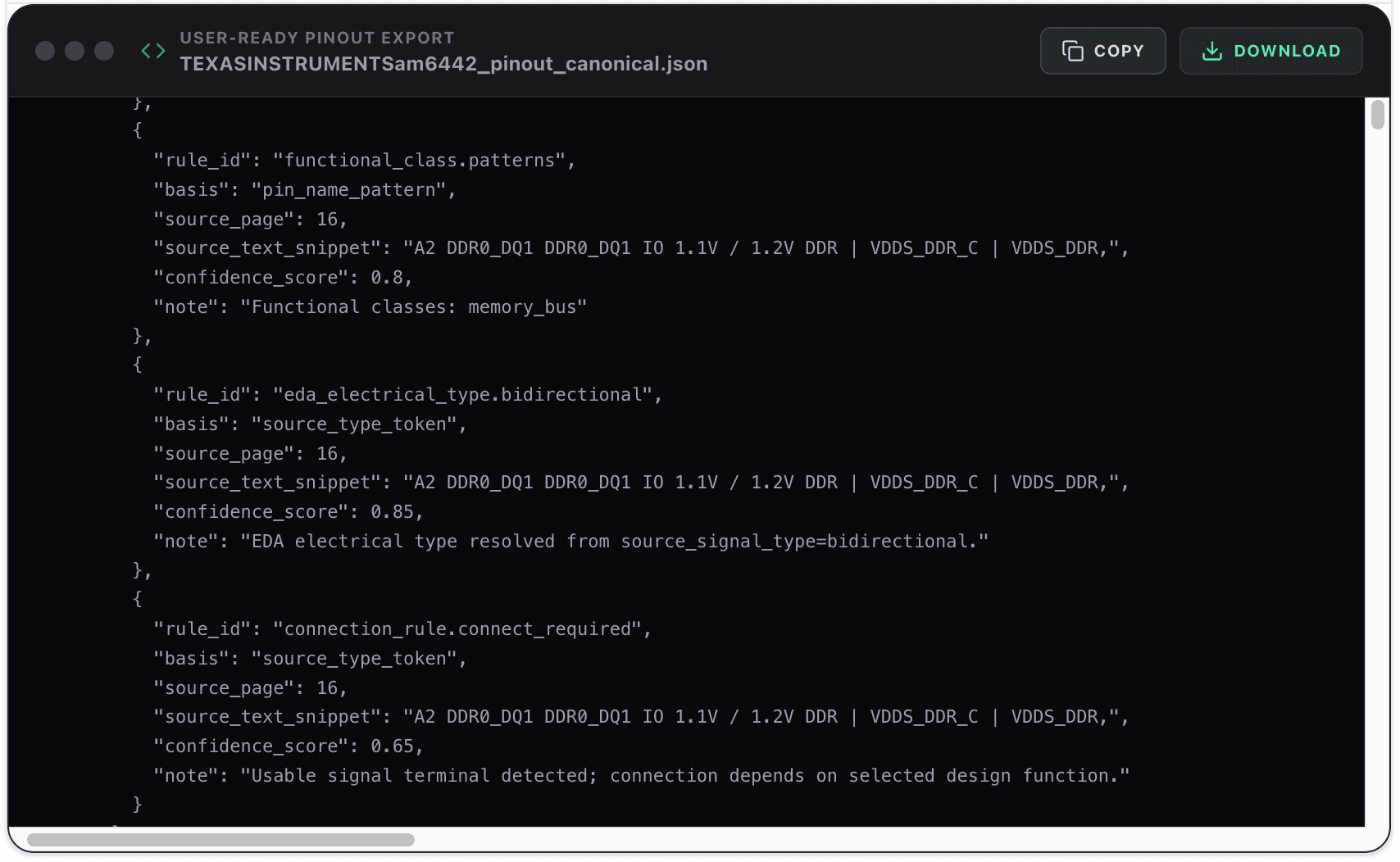
- Provenance: Values carry a confidence score and, where the extraction recorded them, the source page and raw text snippet.
The Core Principle
The model is a sensor. The code is the brain.
We keep the two jobs apart. A large language model (Google's Gemini) reads the uploaded PDF and reports raw facts; some tables are also read in code straight from the PDF's text layer. The geometry, the package rules and the checks live in deterministic code.
- Step 01 · Sensor
PDF Ingestion
Google's Gemini reads the uploaded PDF and reports the tables and values it finds, with their pages. The PDF's own text layer and the document map help pick which pages to read.
- Step 02 · Brain
Deterministic Normalization
Simplified IPC-7351B land-pattern math, JEDEC dimension-symbol-table readers and part-number suffix resolvers check physical geometry and terminal counts.
- Step 03 · Contract
Canonical & Audit Packs
Outputs are structured into typed JSON contracts (canonical.json, audit.json, machine_context.json) with page citations where the extraction recorded them.
- Step 04 · Verification
EDA Toolchain Validation
Each .kicad_mod and .kicad_sym file is loaded with KiCad's own CLI (kicad-cli sym upgrade and fp upgrade) before delivery; the result is recorded as passed, failed or not run. It is a file-format check, not a design-rule check.
Four Ways In
Four operational modalities. One canonical truth.
DatasheetVend serves human engineers, EDA pipelines, other software systems, and AI agents from the same extractions.
Modal 1 · Interactive Human Review
The Engineering Cockpit
Replaces manual transcribing with a review screen. Hardware engineers work in a cockpit that shows pin matrices, multiplexed alternate functions, electrical classifications, power domains, thermal limits, and register maps, with the run's warnings and review state beside them.
- Source pages and snippets beside values, where the extraction recorded them
- Multiplexed alternate-function separation
- Explicit review verdicts and severity-graded warnings
Modal 2 · Automated Land-Pattern and Symbol Synthesis
Deterministic EDA Compiler
Writes KiCad footprints (.kicad_mod) and symbols (.kicad_sym) in code from the datasheet's own dimensions. The land pattern is the datasheet's when it prints one, otherwise simplified IPC-7351B fillet math; each file is delivered with a review status that says whether it was proven against the document.
- Land pattern from the datasheet, or simplified IPC-7351B math
- kicad-cli file-load check, recorded as passed, failed or not run
- Target package resolver (e.g. LQFP144 vs LQFP100)
Modal 3 · Programmable Machine Contracts & MCP
Agent & API Gateway
Scripts, services and AI agents consume typed, versioned JSON contracts over REST and an MCP server, without scraping the app or parsing PDFs.
- canonical.json: the extracted electrical and mechanical facts, in a typed shape
- audit.json: confidence scores and extraction warnings
- machine_context.json: a pin-level context file for AI agents
Modal 4 · Netlist Audit Against Extracted Data
Netlist Cross-Check for CI
A REST endpoint audits a KiCad netlist against the extracted datasheet data and returns findings: unknown pins, unconnected supply and ground pins, wired no-connect pins, supply or ground pins on the wrong net, and the Workbench's electrical rules. What blocks a merge is decided in your own CI.
- POST /api/v1/workbench/crosscheck on a KiCad netlist
- Electrical rule findings, including absolute maximum supply and thermal checks where those modules were extracted
- Components with no attached extraction are reported as unmapped, never guessed
Evidence-Backed Traceability
Provenance you can check against the page.
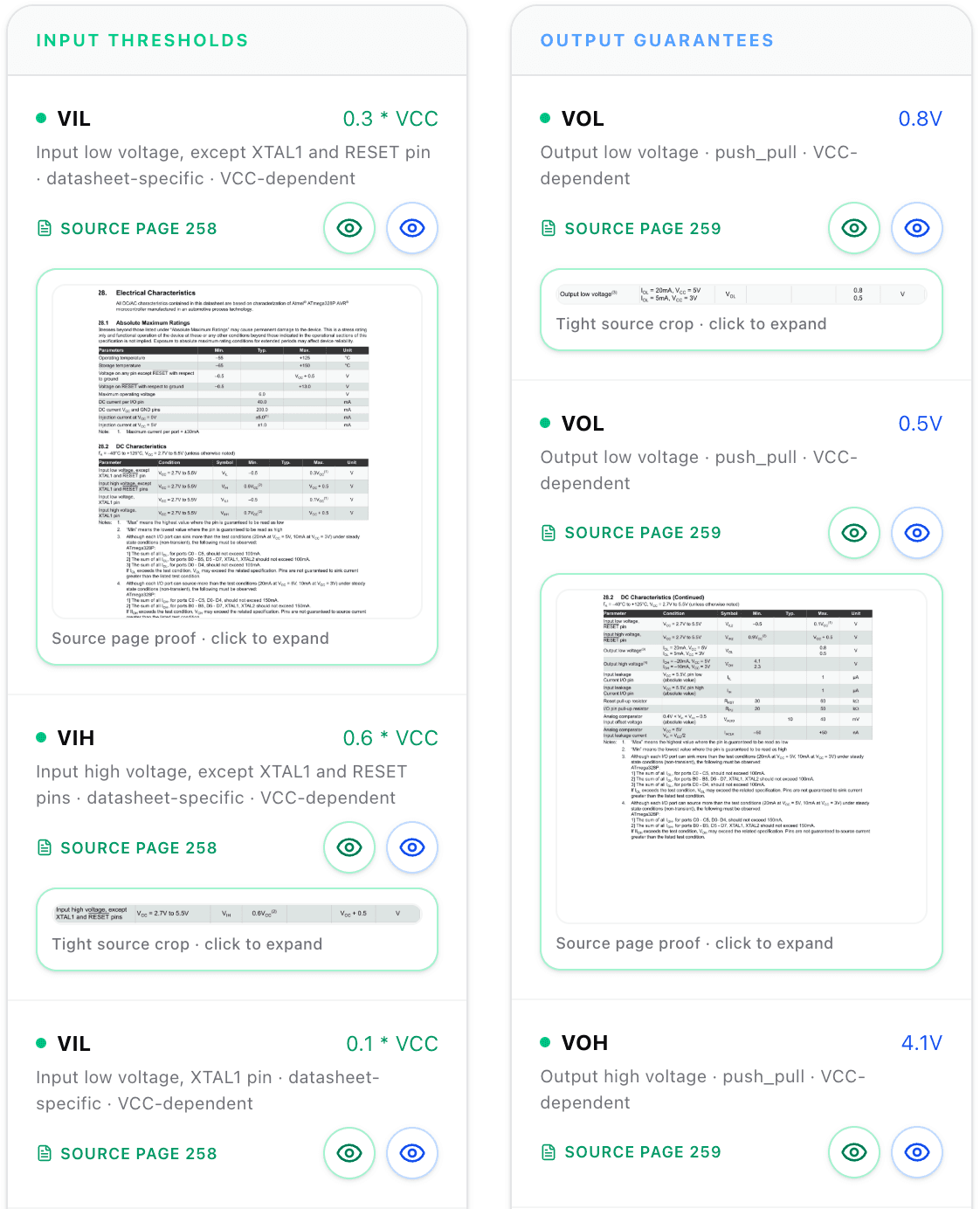
Extracted values carry a confidence score and, where the extraction recorded them, the source page and the source text. Some views, such as Logic Levels, also show the source crop. The checks that produced a result are visible in the JSON.
Strategic Foresight · Autonomous AI Hardware
Why autonomous hardware agents require deterministic truth contracts.
As AI moves from chat copilots toward agents that select components, draft schematics and route boards, the industry faces a truth boundary:
Agents Should Not Rely on Raw PDFs
An agent that parses an ambiguous 200-page PDF layout risks the silent failures described above. Typed contracts with warnings and, where recorded, page references give it something to check.
The Trust Boundary
DatasheetVend provides source-cited limits and rules that a design, or an agent drafting one, can be checked against. Review stays with an engineer.
A Machine-Readable Layer
Turning semiconductor datasheets into auditable, machine-readable contracts that EDA tools and agents can consume.
Canonical Contract Excerpt
Structured machine truth, not loose prose.
One pin of an STM32H743ZI LQFP144 pinout, written in the shape of the canonical pinout contract (canonical.json) and abridged. Its values are from ST's DS12110, Table 9, page 64. Notice the separation between the physical pin class (BIDIRECTIONAL) and the alternate functions the pin can be muxed to; the full contract adds structured_functions, interface_groups and more beside them.
{
  "number": "1",
  "name": "PE2",
  "type": "BIDIRECTIONAL",
  "functions": [
    "TRACECLK", "SAI1_CK1", "SPI4_SCK", "SAI1_MCLK_A", "SAI4_MCLK_A",
    "QUADSPI_BK1_IO2", "SAI4_CK1", "ETH_MII_TXD3", "FMC_A23", "EVENTOUT"
  ],
  "_extraction_meta": {
    "pin_number": "1",
    "pin_name": "PE2",
    "source_page": 64
  }
}
Where this is going
Built toward a complete document-to-engineering workflow
Our goal is to turn technical documents into traceable engineering data and design assets. When extraction encounters missing or conflicting information, a recovery agent selects relevant tools, examines additional evidence and rebuilds affected outputs. Engineering checks determine which findings can be accepted and what still needs review.
Read
A model reads raw facts from the PDF, and code reads the tables it can straight from the text layer.
Investigate
When something is missing or conflicting, a recovery agent picks the right tools and pulls in more evidence.
Validate
Engineering checks decide which findings are accepted: package and pin-count closure, land-pattern math, KiCad CLI and Clang.
Build
KiCad symbols and footprints, Altium assist files, C headers and JSON, each with its evidence and review status.
Preview. Reading, validating and building run in the product today. The recovery agent is in development.
The direction
We turn document evidence into usable engineering outputs, and make their basis, checks and limitations inspectable.
The contract we are building toward
- Every fact has a basis
- Each delivered value points to its source, a derivation or a stated assumption.
- Checks are named
- Each result says what was actually checked, and by which validator.
- Open items stay visible
- Unresolved requirements are listed on the result instead of disappearing.
- Assets keep their evidence
- Generated files carry their evidence and review status with them.
- Failures get investigated
- Recovery digs into a failure instead of silently treating it as missing source information.
Test the extraction engine on your own component PDF
Create an account for five free passes, up to two modules each, on a PDF up to 25 MB. Check any value against the page it names.