Timing Assumptions Are Where Respins Hide
Every microcontroller design rests on a handful of critical timing assumptions: maximum and minimum clock frequencies, setup/hold times for external interfaces, and propagation delays through GPIOs. These assumptions live in timing tables and complex diagrams buried deep inside 1,000-page PDFs, app notes, and errata.
When those assumptions are wrong, or just slightly misinterpreted, the result is intermittent timing violations in production, race conditions between clock domains, or full-blown silicon respins. If you can’t immediately show where a timing number came from, in which datasheet revision, you haven’t truly signed off that interface.
Timing by Copy-Paste and Tribal Knowledge
The typical flow today looks like this: An engineer opens a datasheet, finds a SPI or I²C timing diagram, and manually transcribes tSU, tH, and tPD into spreadsheets or constraint files.
A real example: Table 43 on page 70 of ST's STM32F103 datasheet gives an SPI master a data input setup time of 5 ns minimum and a hold time of 5 ns minimum, with the SPI clock at up to 18 MHz. Three numbers, one table, and each one belongs in your timing budget with that page next to it.
This is fundamentally hostile to manual workflows. Timing diagrams encode multiple parameters in a single graphic. A single constraint might depend on VDD, temperature, or specific synchronous modes. Engineers are forced to mentally map visual timelines to equations, often mis-reading axes or mixing units (ns vs. µs). Over time, the timing spreadsheet becomes an untracked fork of the datasheet.
DatasheetVend Timing: Agent-Readable Constraints
DatasheetVend's timing module converts raw PDF timing content into structured, agent-readable data. Instead of a human scanning a PDF, your verification agents and CI pipelines can query a timing API directly.
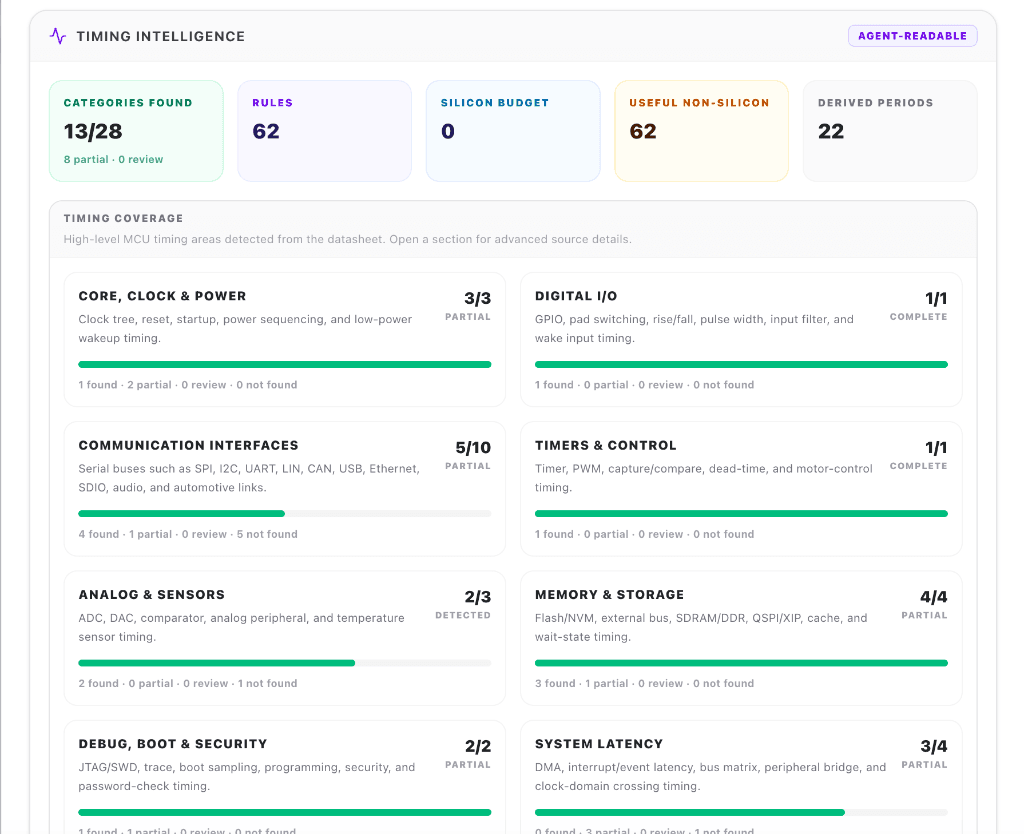
The Timing Intelligence dashboard detects and categorizes timing coverage across Digital I/O, Communication Interfaces, Timers, and more.
The module reads setup and hold times, clock frequencies and delays, keeps each value's unit and the conditions it depends on, and, most importantly, keeps the page each value came from.
Handling Complex Interdependencies
Modern microcontrollers have dozens of interfaces and multiple clock domains with conditional timing clauses ("valid only when f_cpu <= 48MHz"). DatasheetVend doesn't just extract flat numbers; it keeps the condition a value depends on, such as a clock frequency or a supply voltage, next to the value.
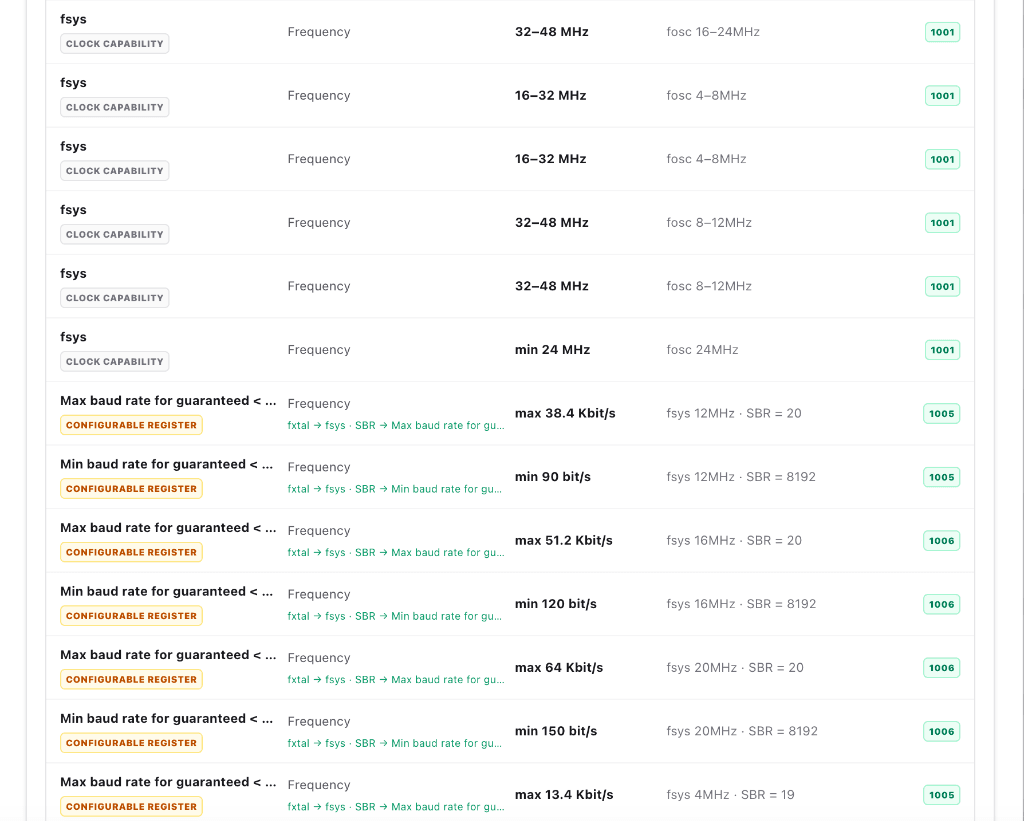
Detailed breakdown of clock capabilities and derived baud rate conditions automatically extracted from dense tables.
A Signoff Artifact, Not a Best-Effort Spreadsheet
When a team relies on a mix of spreadsheet constraints and partially updated diagrams, board routes and MCU timing can combine to push margins dangerously low. With DatasheetVend, you get a checkable constraint payload: every value with its unit, its condition and its page. It is review-level data; an engineer still signs off the margins.
- Pre-layout sanity checks: Your own scripts can compare route delays against the machine-readable datasheet values before fabrication.
- Continuous timing linting: Your CI can check configurations against the same values, so a changed clock setting meets the table it depends on.
Engineers looking to automate datasheet extraction beyond a single script will find the full scope of what's possible on the DatasheetVend platform , from AI-backed pinout parsing to structured canonical JSON outputs. If you are evaluating this for a team or enterprise workflow, the solutions overview covers the available integration paths, and the API documentation has every endpoint, request schema, and response contract you need to build against. For teams comparing providers or budgeting for tooling, the pricing page lays out each tier directly.
How many of your timing numbers have a page?
A new account gets five free passes. Each pass runs up to two modules, pinout and footprint included, on a PDF up to 25 MB.