The Cost of Confusion: Red Lines vs. Safe Zones
Absolute Maximum Ratings are not where a component is meant to operate; they are the stress limits that should never be exceeded, even briefly. Yet in real engineering workflows, these limits are still copied by hand from inconsistent PDFs, increasing the risk of transcription errors, misread tables, and confusion with the recommended operating conditions.
DatasheetVend's Absolute Maximum Ratings module turns that table into JSON, with the page and a confidence score for each rating.
Almost every datasheet has two distinct tables: "Absolute Maximum Ratings" (stress limits: beyond them the part may be permanently damaged) and "Recommended Operating Conditions" (the range the part is meant to work in). A script that grabs the first supply voltage it finds can pick up the absolute maximum instead of the operating value, and then you are designing against the wrong number.
A real pair: in ST's STM32F103 datasheet, Table 6 on page 37 lists VDD - VSS up to 4.0 V as an absolute maximum, while Table 9 on page 38 gives the standard operating voltage as 2 V to 3.6 V. Design to the second table. The first is a line you must never cross.
Why Manual Extraction Fails
Extracting these values by hand is an operational liability. Tables vary by manufacturer, package, and part family. Key values may be scattered across sections, hidden in footnotes, or labeled inconsistently (e.g., power supply voltage vs. VDD vs. VCC). Manual copy-pasting introduces transcription errors and stale records, and crucially, teams cannot easily audit which PDF page or table row produced a value.
The DatasheetVend Approach: Verifiable JSON
DatasheetVend reads absolute maximum ratings straight from the datasheet into machine-readable output. Each rating carries its parameter, symbol, min_value, max_value, unit, condition and confidence_score, and its evidence says which page and table it came from. The recommended operating values go in a separate list. Here is that shape, abridged, with the STM32F103 values above:
{
  "data": {
    "data": {
      "canonical_output": {
        "ratings": [
          {
            "parameter": "External main supply voltage (including VDDA and VDD)",
            "symbol": "VDD - VSS",
            "min_value": -0.3,
            "max_value": 4.0,
            "unit": "V",
            "evidence": {
              "source_page": 37,
              "source_table_title": "Table 6. Voltage characteristics"
            }
          }
        ],
        "recommended_operating_boundaries": [
          {
            "parameter": "Standard operating voltage",
            "symbol": "VDD",
            "min_value": 2,
            "max_value": 3.6,
            "unit": "V",
            "source_page": 38
          }
        ]
      }
    }
  }
}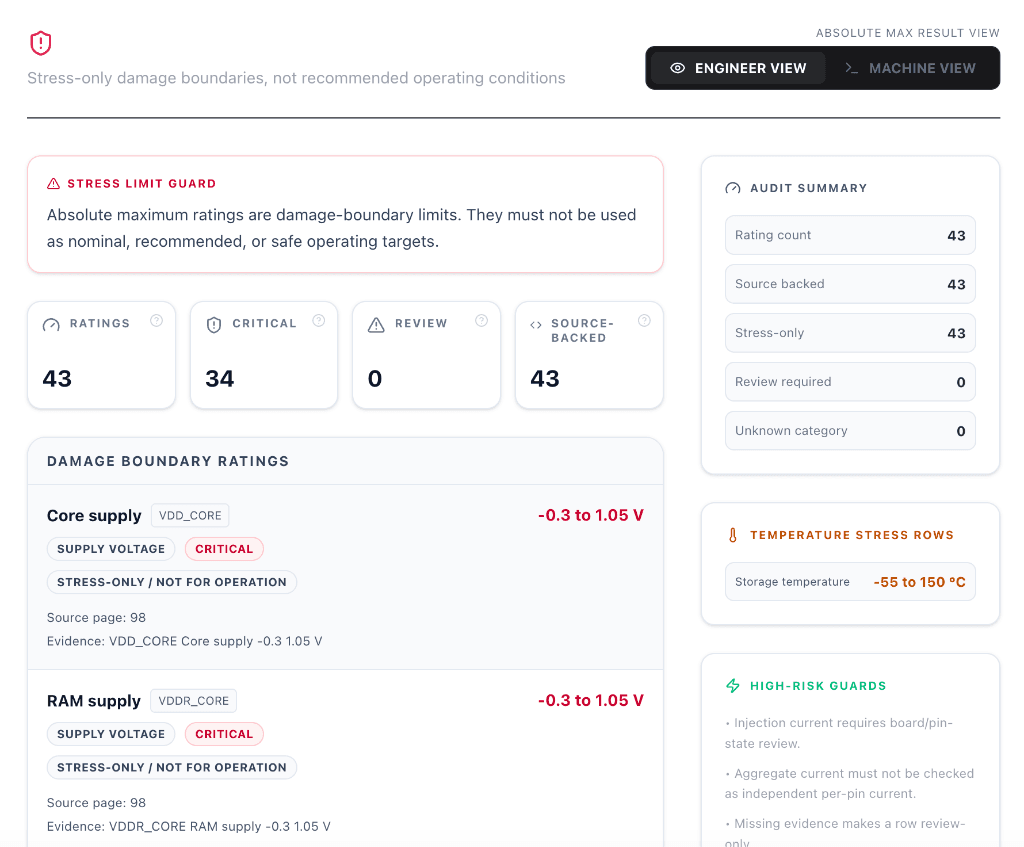
The DatasheetVend dashboard shows the stress limits with their sources and warnings.
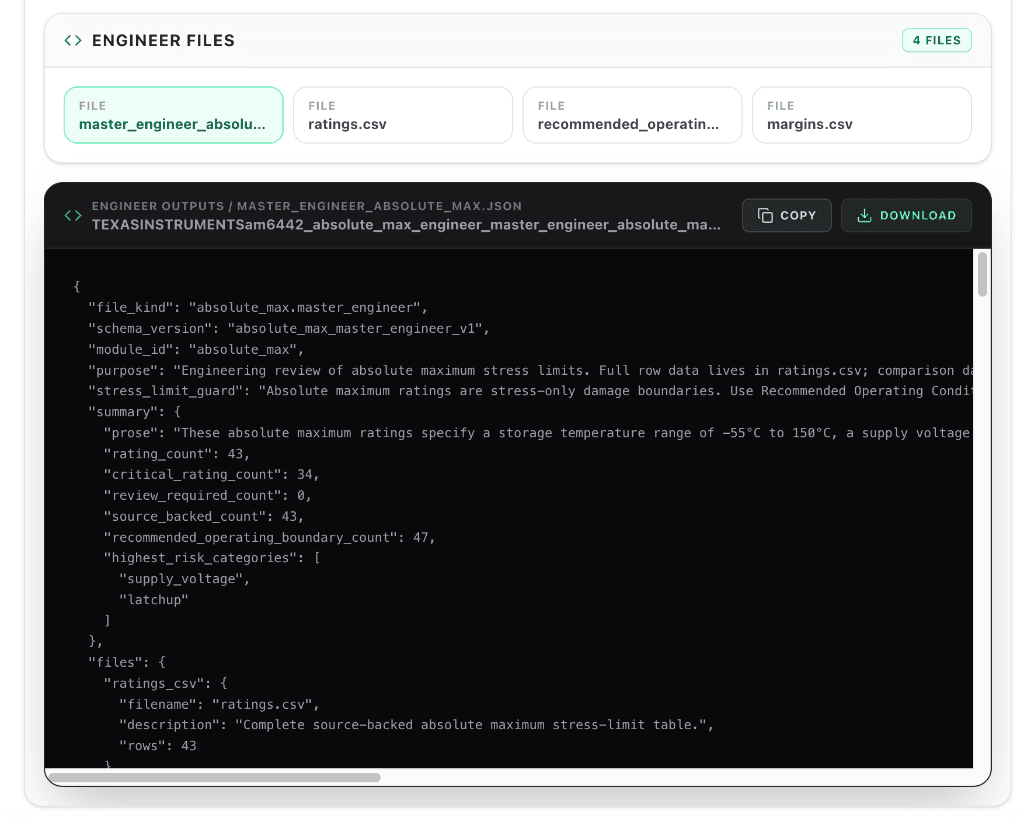
Engineers can inspect the JSON payload behind the dashboard.
Automation Without Provenance is Just Faster Guessing
The real challenge isn't just extracting the data; it's trusting it. That is why every rating keeps its page, its table title and a confidence_score, and a rating without a unit is flagged for review instead of guessed. We don't just give you the answer; we give you the trail back to the source document, so an engineer can check a value against its page instead of trusting it.
- Hardware Engineers: Avoid overstress during design and check part selection against the real limits.
- Procurement Teams: Compare alternate parts on the same fields, with an engineer signing off.
- EDA Librarians: Keep auditable libraries with every rating in one shape.
Explore DatasheetVend
Don't cross the red line.
A new account gets five free passes. Each pass runs up to two modules, pinout and footprint included, on a PDF up to 25 MB.